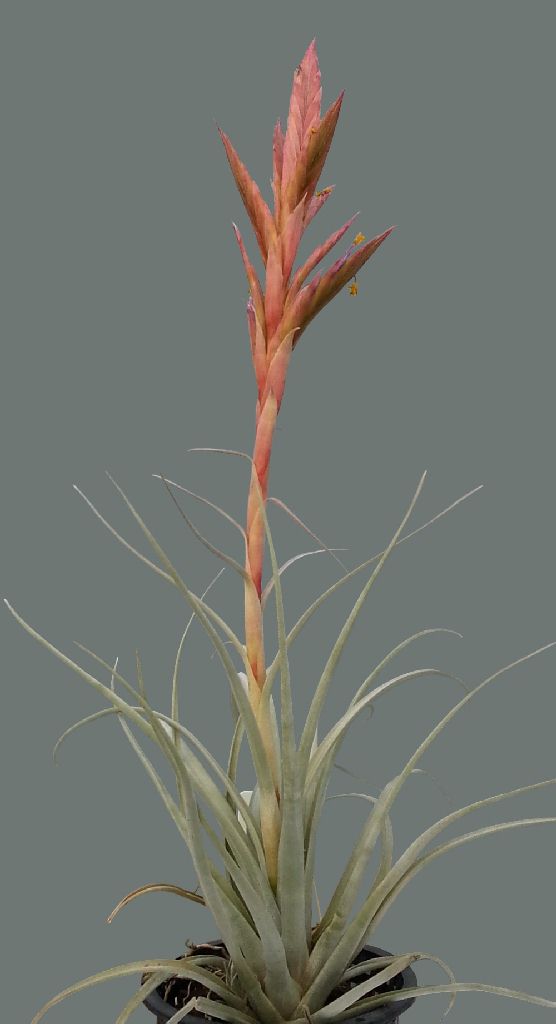
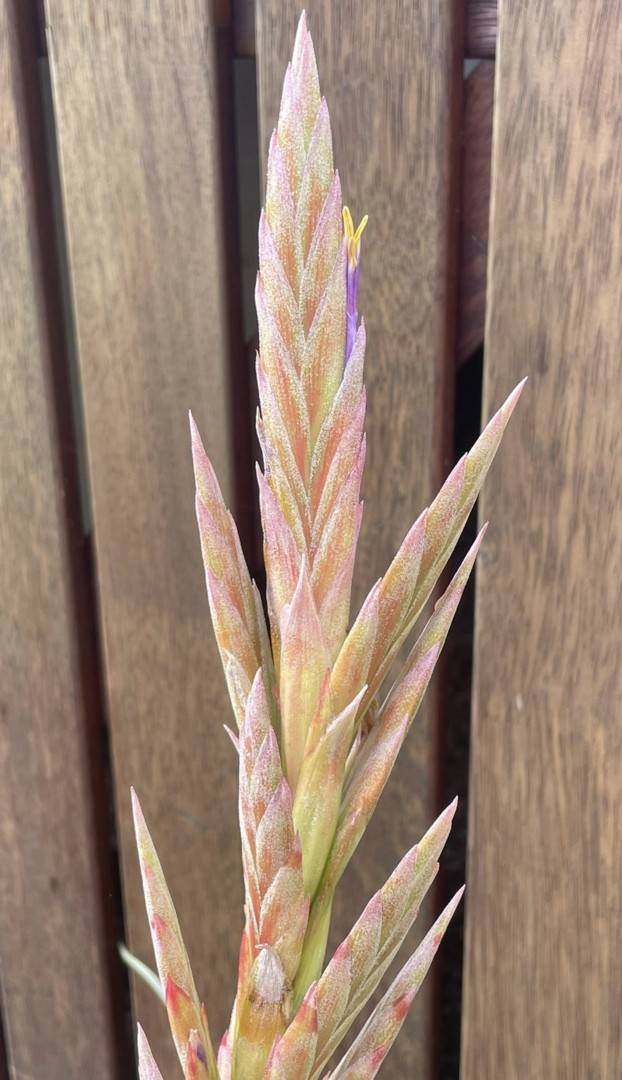
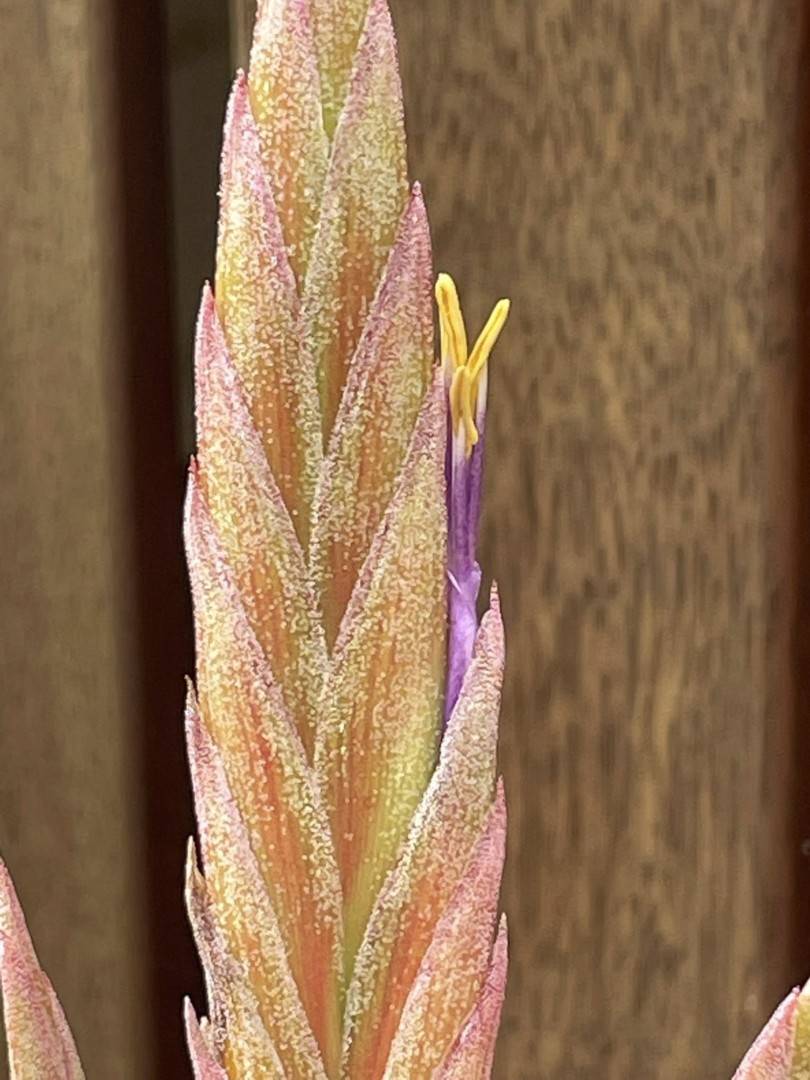
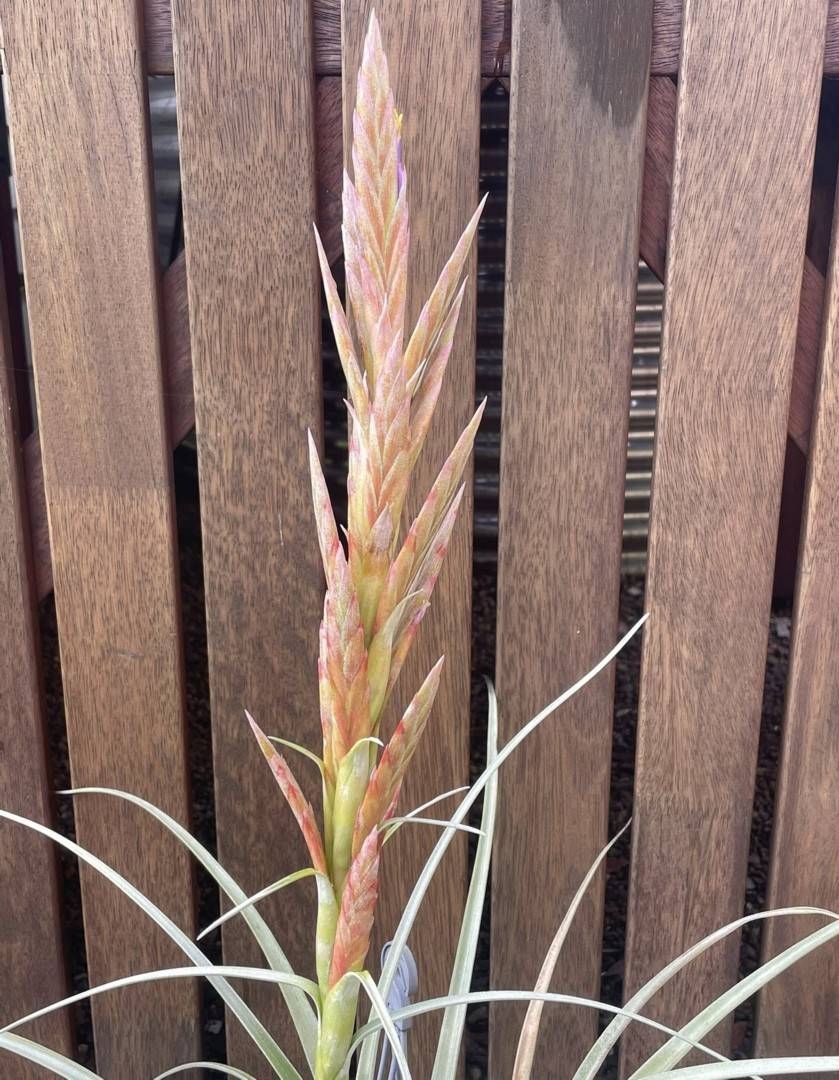
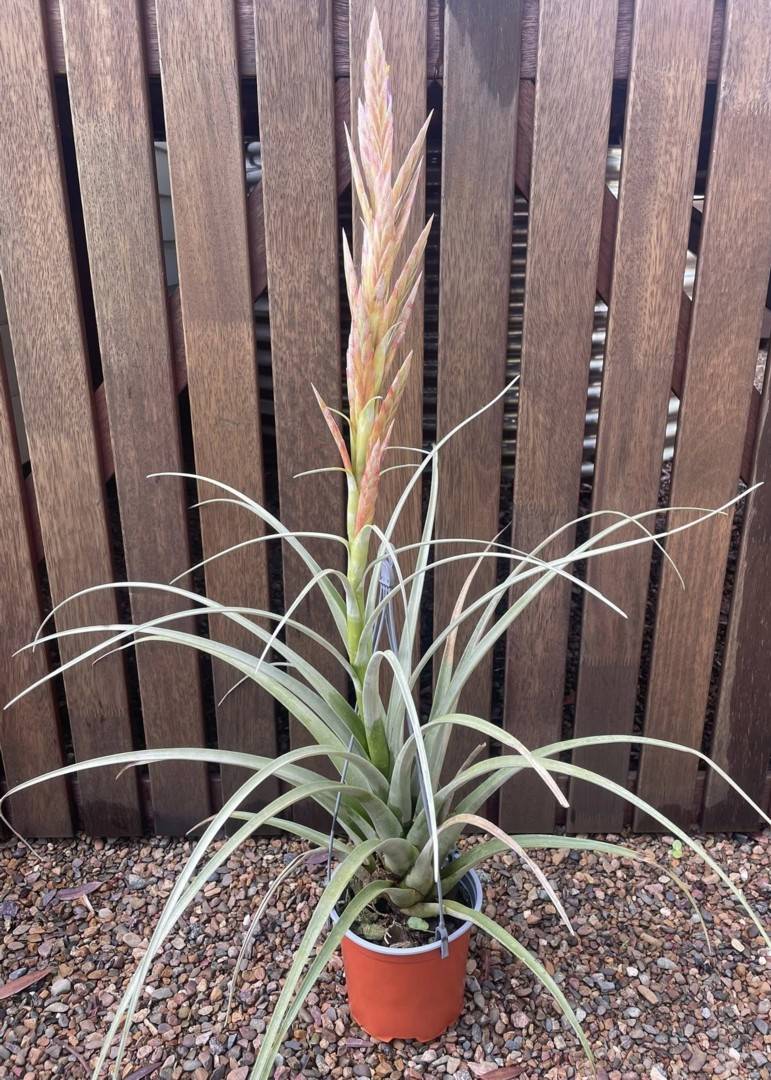
Rosette funnel-form, leaves 25-30, offsetting freely.
Leaf 41-54 cm long, the blade 25-50 mm wide, narrowly triangular, canaliculate, cinereous-lepidote adaxially and abaxially, nerved (dry).
Leaf sheath 7-12 cm long, 4-7 cm wide, elliptic, narrowing at the union with the blade, pale brown-lepidote abaxially and adaxially.
Scape stout, erect, 18-30 cm long.
Scape bracts imbricate, concealing the scape; sheath glabrous. No.261 cherry, the blades long, deflexed, gray-green lepidote (may be flushed maroon).
Primary bracts No.26 cherry, nerved (fresh or dry), sheath glabrous, the recurved blades lepidote.
Inflorescence erect, pinnate, 20-40 cm long, the internodes 8-25 mm long.
Branches elliptic, 5- to 10-flowered, dorso-ventrally compressed, strict, spreading only 15 to 20 degrees, with 2 or 3 sterile bracts at the base, the lowest often bicarinate.
Floral bracts lanceolate, conduplicate, keeled, beaked, No.26 cherry, with scattered trichomes on the adaxial surface, the abaxial surface distinctly nerved (fresh or dry) especially in the apical half, polished except lepidote on the margins and apices, 39-42 mm long, 15-20 mm wide.
Sepals elliptic, strongly keeled posteriorly, connate 1/4 to 1/2 the length, 34-35 mm long, 9-11 mm wide.
Petals spatulate, erect, with a slight sinus on each side of the blade, the apex rolled back, No.47 lavender with white edges, 44-50 mm long, 8-9 mm wide.
Filaments with lengths unequal in 2 sets of 3 each, the distal 1/3 flattened, broadened, No.47 lavender, 51-63 mm long.
Anthers 4 mm long, attached 1/3d – 1/2 of the length from the base, the pollen dark yellow, the endothelium brown.
Style white, occasionally with lavender spots below the stigma, 47-58 mm long excluding the ovary.
Stigma greenish, the lobes erect, slightly twisted, papillose.
Flowering in February-March, morning to early afternoon.
Etymology: Named for the Mexican state of Aguascalientes where the species was discovered.
Type: MEXICO: AGUASCALIENTES: saxicolous on rock walls and boulders, alt. 2000-2200 m.1980, Gardner 1322 (Holotype: SEL; Isotypes: US, MEXU).
Additional material examined: MEXICO: AGUASCALIENTES: Rinc6n de Ramos, 1980, Gardner 1324 (SEL).
Numbers associated with color references refer to color chart in Exotica by A. B. Graf. J. Roehrs Company. Rutherford. New Jersey
From McVaugh in Flora Novo Galiciana 1989
Tillandsia aguascalientensis C. S. Gardner, Selbyana 7: 361. fig. 1. 1984.
Saxicolous, on rock walls and boulders, 2000-2200 m on the Central Plateau, flowering Feb-Mar.
Ags., known only from the type, from an unspecified locality (Gardner 1322!, the holotype-see note at bottom), and from a paratype (Rincon de Romos {"Ramos"}, Gardner 1324, said to have been collected at a spot ca 40 km from the type-locality).
Plant acaulescent, offsetting freely, 40-70 cm tall at flowering time;
leaves 25-30 in a funnelform rosette, ca 40-55 cm long;
sheaths elliptic, narrowing at the union with the blade, 7-12 cm long, 4-7 cm wide;
blades narrowly triangular, canaliculate, 2.55 cm wide near base, pale-lepidote, nerved when dry;
scape stout, erect, 18-30 cm long;
scape-bracts imbricated, concealing the scape, with glabrous cherry-colored - sheath and long-caudate, often strongly deflexed, gray-green-lepidote blade;
inflorescence erect, pinnate, fusiform, 20-40 cm long;
branches 5-10-flowered, dorsiventrally compressed, separated by internodes 0.8-2.5 cm long, appressed ascending, with 2-3 sterile bracts at base;
primary bracts like the upper scape-bracts but only the lower ones caudate;
floral bracts lanceolate, conduplicate, keeled, with an incurved beaklike tip, cherry-colored, the abaxial surface nerved (fresh or dry) especially in the apical half, lepidote on tips and margins, otherwise polished, 3.9-4.2 cm long, 1.5-2 cm wide (when flattened); sepals elliptic, ca 3.5 cm long, 9-11 mm wide, the adaxial pair strongly keeled, connate up to half their length;
petals spatulate, erect, ca 5 cm long, lavender with white edges or "mauve" (G);
stamens and pistil exserted;
stigma-lobes erect, slightly twisted;
fruit unknown.
According to the protologue, Tillandsia aguascalientensis is related to T. dugesii Baker (J. Bot. Brit. & For. 25: 278. 1887, the holotype from Guanajuato {?near Santa Rosa}, Duges in 1885, K), but differs from that species in having the branches of the inflorescence strictly appressed, not spreading, and the floral bracts distinctly nerved (not "even, glabrous, lustrous") and lepidote on tips and margins but otherwise lustrous. Apparently T. dugesii has not been reported from Nueva Galicia, but it is a plant of central Mexico, known from central Gto. and central Mich., to Mex., Qro., Oax., and Pue.
Note
In 1980 C. S. Gardner traveled widely in Mexico, collecting Tillandsia first on the Atlantic side of the country, then crossing via Durango and Mazatlan to the Pacific side, and continuing southeastward along the highways to Tepic, Puerto Vallarta, Tomatldn, Manzanillo, Colima, Pihuamo, and eventually to Morelia. She made 35-40 collections in Nueva Galicia (at least 1321-1324, and 1335-1367). Some of the collections and localities were subsequently cited (Gardner 1982, and elsewhere), but the pertinent data for most of the collections were lost with her fieldbooks in an automobile accident, so not all of her localities can be precisely named. Through the kindness of Dr. Gardner, I was enabled to study the original set of her collections, including the holotypes of two recently described species, in her private herbarium at Corpus Christi, Texas. Significant numbers are cited below, with localities given as fully as possible.