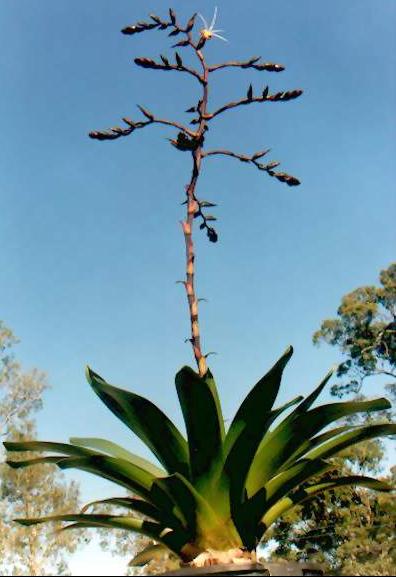
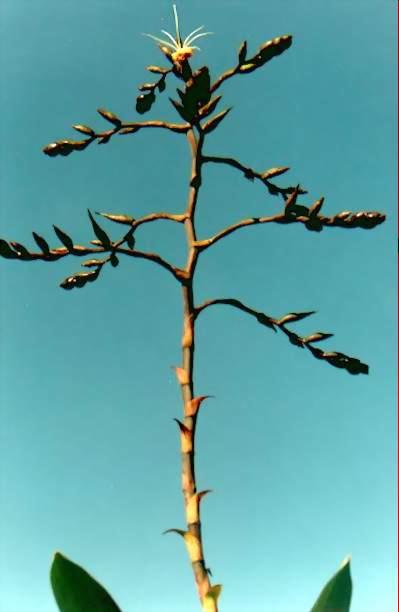
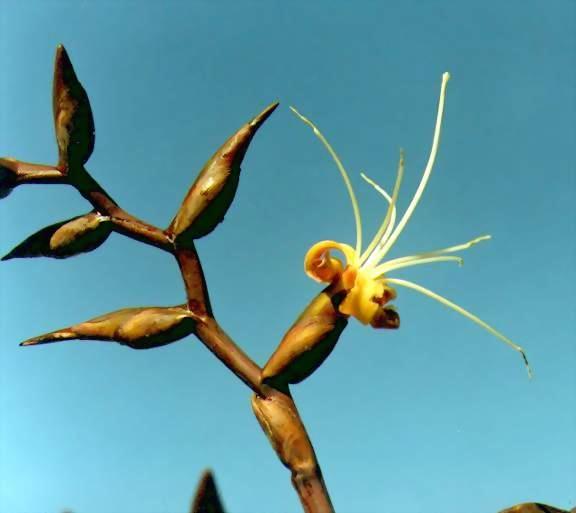
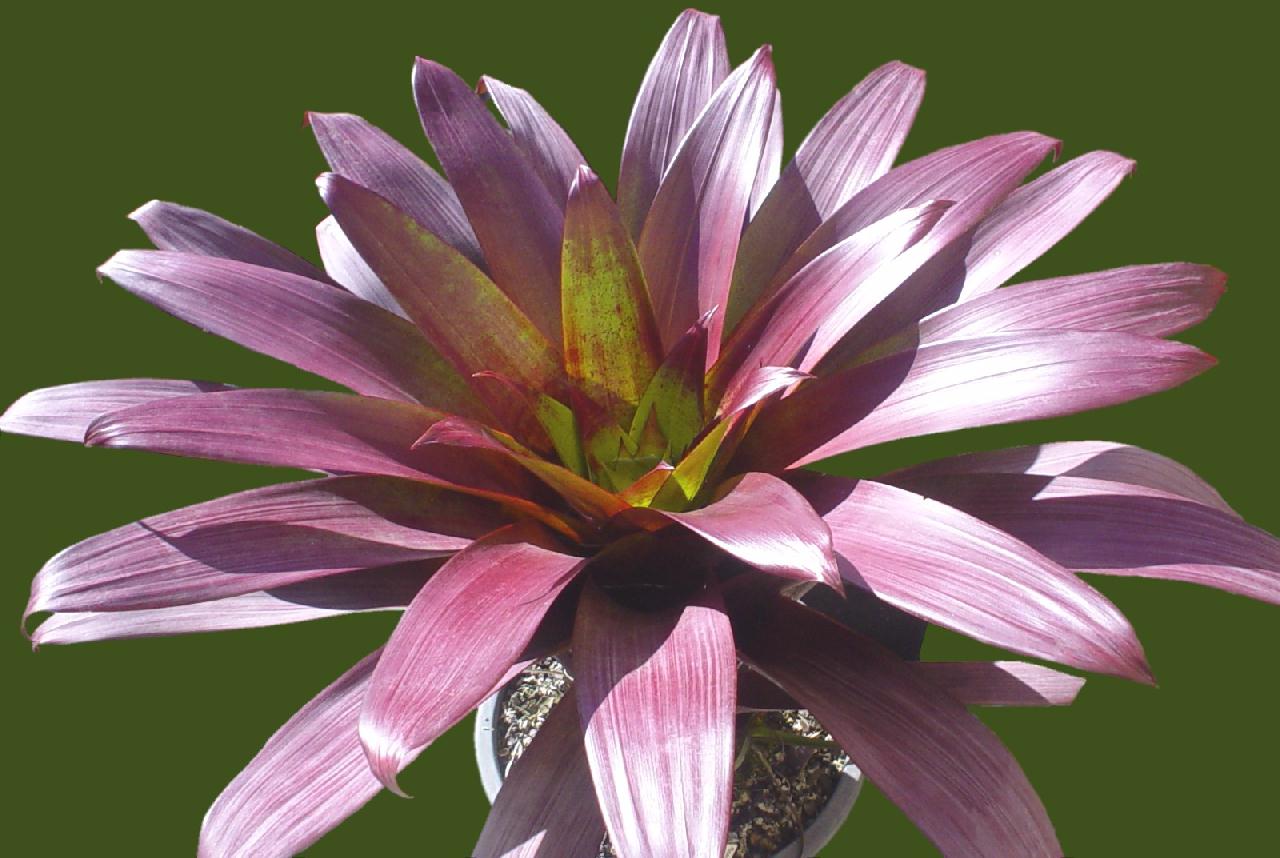
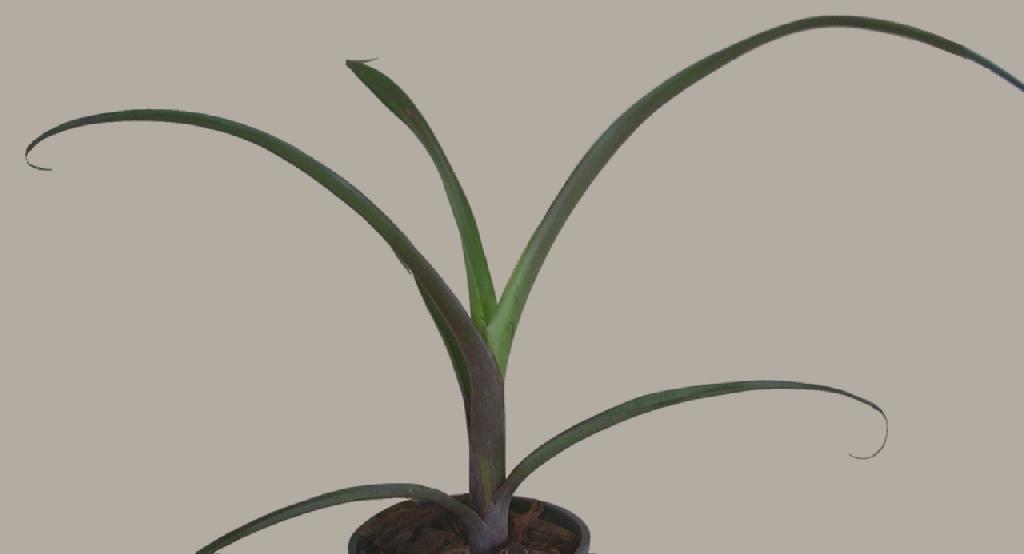
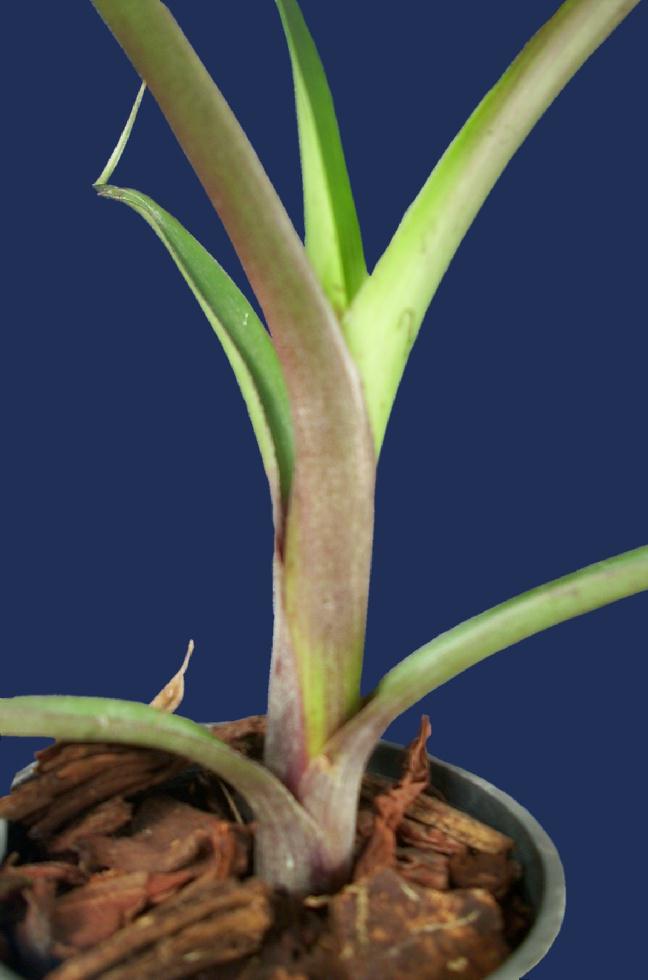
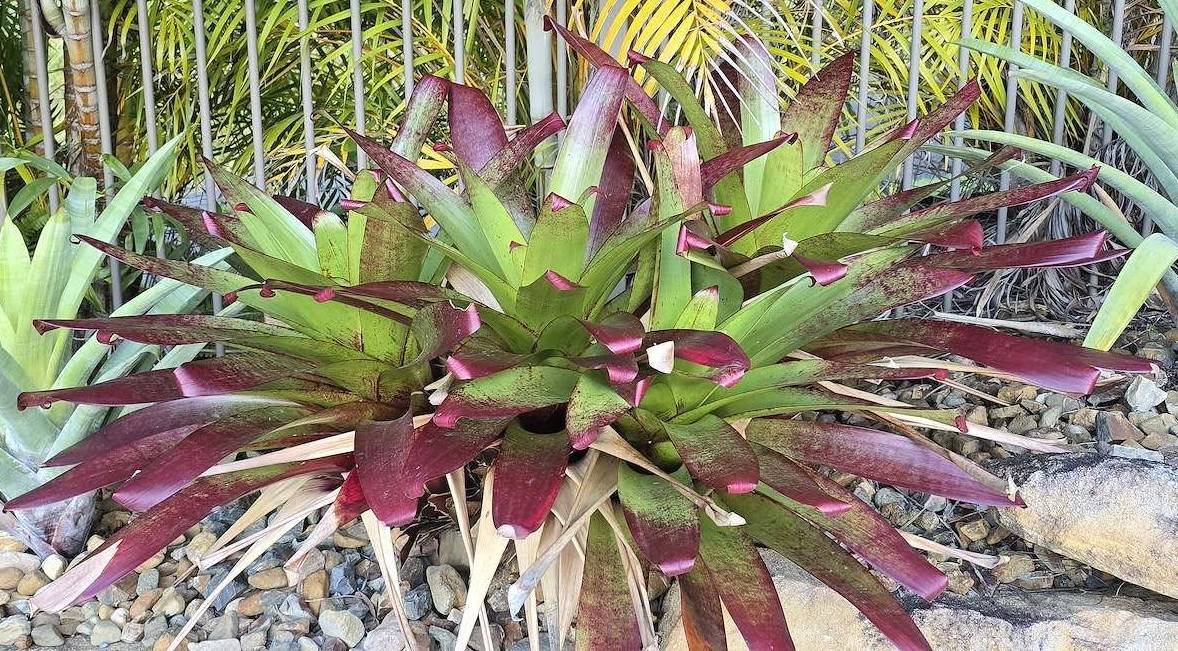
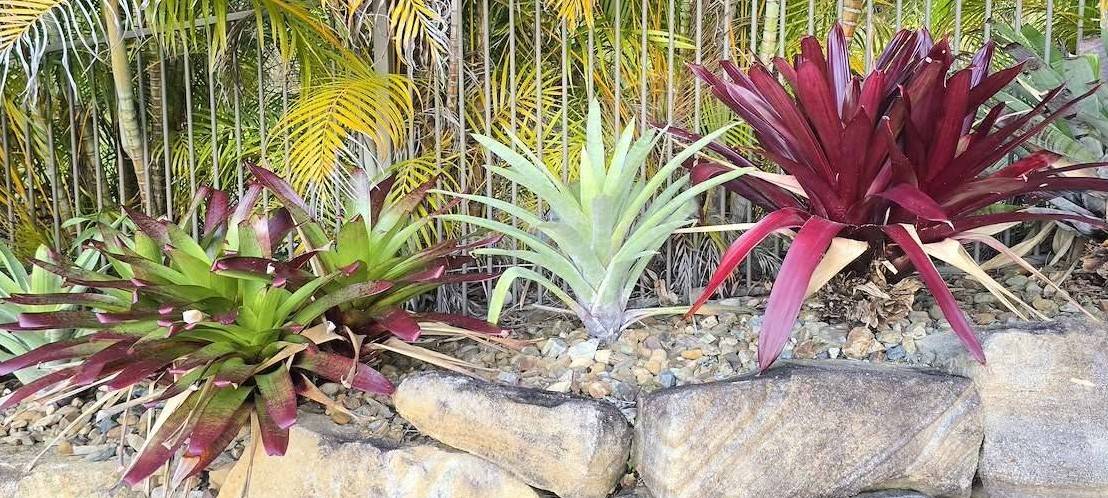
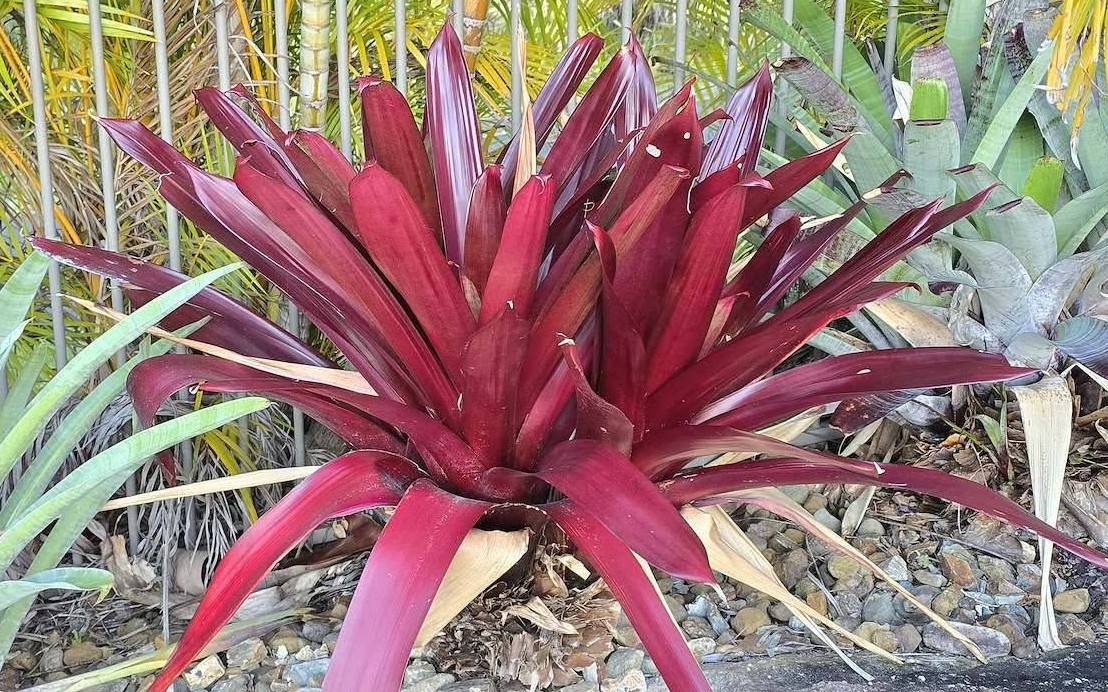
original vinicolor clone and a red clone, from a seedling |
Desc from S&D
246a. Vriesea vinicolor E. Pereira & Reitz, Bradea I: 386, pI. 4, figs. 8-11. 1974. Fig 467 M-R.
Plant flowering 1.6 m high.
Leaves in a dense crateriform rosette, 60 cm long, rigid, coriaceous;
Sheaths subovate, 20 cm long, 16 cm wide, dark castaneous, densely pardaline-lepidote above, inconspicuously lepidote beneath;
Blades sublinear, long-attenuate and then short-acuminate, 10 cm wide, green below, the upper half vinaceous.
Scape erect, 15 mm thick, purplish;
internodes 5 cm long;
Scape-bracts spreading toward apex, vinaceous beneath, green and lepidote above, the lower imbricate, subtriangular, long-acuminate, 8 cm long, 6 cm wide, the upper much smaller, short-acuminate, shorter than the internodes.
Inflorescence laxly bipinnate;
Primary bracts very broadly ovate, rounded and apiculate, 30 mm long, 45 mm wide, shorter than the sterile bases of the branches, vinaceous;
Branches 4, spreading, 25-35 cm long with 12-15 distichous flowers, the sterile base 10 cm long with 2 bracts;
Rhachis geniculate, purplish; internodes 15 mm long.
Floral bracts suborbicular, cymbiform-inflated, emarginate and minutely apiculate, 3 cm wide extended, obtusely carinate or ecarinate, dark purple;
Flowers a little secund upwardly, nocturnal, not imbricate;
Pedicels 10 mm thick.
Sepals broadly ovate, acute, 30 mm long, much exceeding the floral bracts, pale vinaceous;
Petals linear-lanceolate, acute, 8 cm long, 10 mm wide, soon flaccid, bearing 2 entire, 7 mm long scales at base;
Stamens free, 10 cm long;
Ovules long-caudate.
Type. Vargem Alta, Espirito Santo, Brazil, cultivated in Jardim Botanico do Rio de Janeiro, 23 Aug 1973, A. P. Duarte s n (holotype HB 60156 n v).
DISTRIBUTION. Known from the type collection only.
According to the authors, Vriesea vinicolor is related to V. extensa L. B. Smith and V. imperialis Carriere. It is said to differ from the former in its floral bracts being nongibbous and its petals equaling its stamens, and from the latter in the shape of its inflorescence, bracts, and sepals. If the petals and stamens are truly equal Vriesea vinicolor does not belong in the subgenus Alcantarea or requires redefinition of that subgenus. However, it should be noted that the measurements given are quite unequal with the petals 8 cm and the stamens 10 cm.