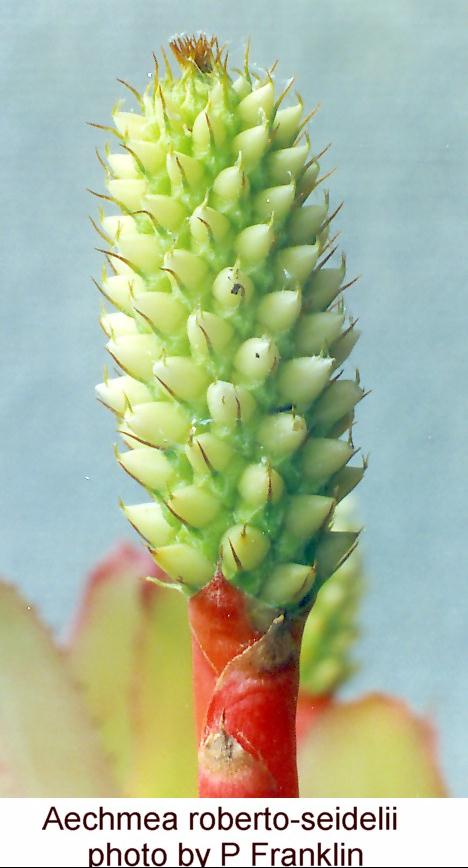
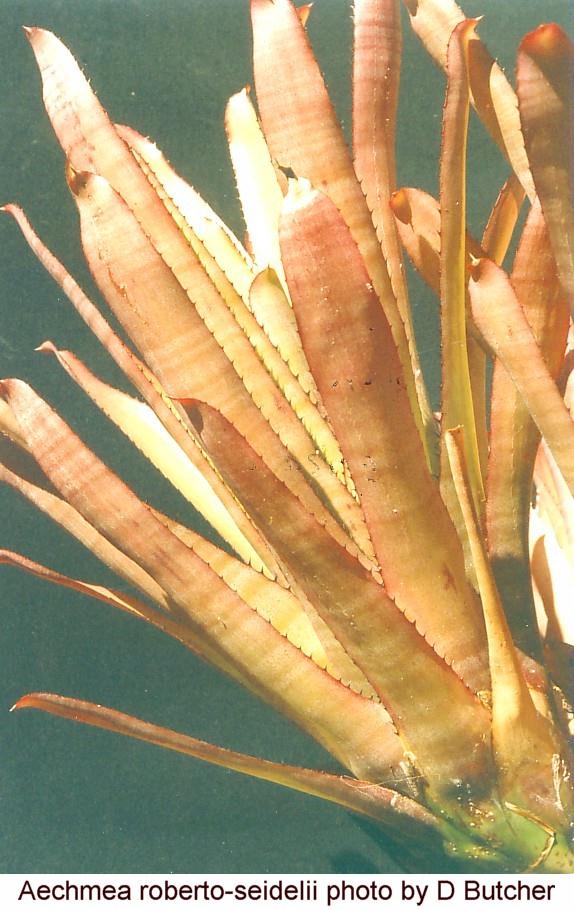
Photos - P.Franklin / D.Butcher. 02/14 update - now back to guarapariensis |
In the Journal of Bromeliad Society 49: 168. 1999 I was pleased to see that Bruno Silva and Elton Leme had at last found a ‘true’ A. triticina which was nothing like what we had been growing. So I hung on to the name A. guarapariensis even though it took a long time to write a label.
I had to wait another 8 years before having yet another change. In Journ. Brom. Soc. 57: 159-161. 2007 Tania Wendt considered that A. guarapariensis was really the earlier published A. roberto-seidelii. I quote as follows :
“The difficulties in the application of the correct name are associated to the complex taxonomic history involving Aechmea roberto-seidelii with Aechmea guarapariensis, Aechmea triticina Mez and Aechmea pineliana (Brong. ex Planch.) Baker.
During my revision of the subgenus Pothuava (Wendt 1997), which includes these species, I considered Aechmea guarapariensis and Aechmea roberto-seidelii as synonyms of Aechmea triticina. My interpretation was based on the similarity among type collections and also on the information of the original description that mentioned white or greenish floral coloration for all three taxa.
Aechmea triticina was described by Mez in 1896, but since its discovery it has been poorly understood due to the absence of original drawings and insufficient herbarium material. In 1999, Silva & Leme collected a plant that they considered to be the true Aechmea triticina, which exhibits flowers vividly rose to lilac. They considered that the characteristic of greenish flowers attributed to Glaziou (the collector of type specimens of Aechmea triticina) by Mez (1892) in the protologue is certainly a mistake. Whoever is right or wrong about the colour of the flower of the type specimens we will never know.”
So please change your label to Aechmea roberto-seidelii if it looks like an A. pineliana with white flowers. If you look at Smith & Downs you will see that this plant was treated as a synonym of A. pineliana var. minuta to show how similar they are in looks!
Just one word of warning. In the 1980’s there was a plant being grown as A. roberto-seidelii but was really an A. warasii in disguise!
Update - February 2014.
From Eric Gouda... "It is unclear how to look at the description in Smith & Downs of Aechmea triticina, but I will keep A.roberto-seidelii as well as A. guarapariensis as separated species. Both are from total different biome and much different in size, one epiphyte and one terrestrial and the large apical coma in the inflorescence of one of the species are good enough for me."
From Derek Butcher... "In other words we only seem to have A. guarapariensis in Australia.
We do know we don't have A. triticina and our plant comes out between the descriptions of A. roberto-seidelii and A. guarapariensis but
we do not know where it was collected in the wild. It seems safer to use A. guarapariensis. Tania Wendt has not sold her idea to Eric and he feels it is safer to keep the names apart from a Botanist's point of view. The definitions of the 3 has not changed, it is the interpretation that has varied.
Update - August 2017.
From Kerry Tate (The Channon, NSW)... "I dare to disagree with Derek on the Ae. guarapariensis suggestion. I do grow that species (guarapariensis) and its habit and size are true to the description. Ae. guarapariensis is much larger than the bromeliad in Facebook question, which keys to the description of Ae. roberto-seidelii. I grow both and have studied and compared them closely. They might eventually be accepted as variations of the same species, but while they are still separate species, I will err on the specifics of their descriptions.
Kerry's side-by-side description, Feb 2018 - "The growth habit is quite different between the epiphyte and the terrestrial. The stolons are longer, heavier and lateral on guarapariensis - hence its tendency to sprawl along the ground, and eventually form massive clumps (as in my own backyard). I too grow roberto-seidelii under differing conditions, as well as Ae. guarapariensis. The latter is twice the height and weight of roberto-seidelii, and has much stiffer leaves, which remain greenish with slight silver barring. roberto-seidelii forms dense clumps, with a very short stolon. It's leaves will go much redder from stress - due to strong light, and lack of nutrients. Re the morphological differences, yes they are minor - but the lengths of certain 'parts', e.g., whole cone-shaped spike and sepal spines, differ between the two species."
Photos - P.Franklin / D.Butcher. 02/14 update - now back to guarapariensis |
Aechmea guarapariensis. Pereira & Leme Brasil Florestal – No. 59: 40. Jul/Sept 1984
Plant flowering ca 1.2m high, terrestrial.
Leaves ca 40, ligulate, forming a funnel-shaped utriculum at the base.
sheath elliptic, 18cm long, 12cm wide, entire, inside lightly purple, outside pale green, both sides brown lepidote spots.
Blades linear, 40 – 75 cm long, 6 – 8cm wide, narrow near tip, green or purplish, lower part lightly white banded, both sides almost appressed dense lepidote forming a membrane, the tip obtuse and mucronate, edges densely spined, spines 1- 2mm long, dark purple, small directly near the tip.
Scape erect, 70cm long, 10mm diam when living, dense white wooly and purple lined, totally hidden by the bracts.
Scape bracts linear, narrow toward the tip, ending obtuse and mucronate, about 14cm long, 4cm wide, outside red, inside white, both sides dense white lepidote toward the tip, margins spiny toward the tip, much longer than the internodes and all of the sheath, towards the top of the inflorescence kidney-shaped, 2cm long, 3cm wide with rounded tip and mucronate.
Inflorescence a simple spike, cone-shaped, cylindrical ca 15cm long, 3cm diam, tip with a small hairy coma. Axis conspicuously never tomentose.
Floral bracts concave, suborbicular, 7mm diam. except for spine, the back obtuse tricarinate and white lepidote, entire, membranaceous, green, never fully covering the ovary, at the top a 5mm long brown spine which in life higher than the sepal never equaling.
Flowers 15mm long, sessile, subspreading.
Sepals ovate, asymmetirc, free, 8mm long, greenish yellow, nerved when dry, not keeled, lightly white lepidote, tip with small curved spine.
Petals narrow ovate, 10mm long, tip acute, white spreading through anthesis, above the base two fimbriate ligules.
Stamens included, Filaments cylindric, 1st series adnate, 2nd series free, Anthers linear 3mm long, obtuse, dorsifixed at base, Epigynous tube 1mm long,
Ovary lightly complanate, 3 – 4mm long, green, white lepidote. Placenta joined to the tip of the loculus, Ovules long caudate.
Type State of Espirito Santo, Municipality of Guarapari, terrestrial in Restinga. leg EMC Leme #92 Feb 1978, flowered in cultivation 20 Sept 1983 Holotype HB Isotype US
Undoubtedly, this new species has similar characteristics to A. pineliana (Brong. ex Planch.) Baker and to A. alopecurus Mez, however, it differs from the first by the white corolla, as well as the floral bracts and sepals being unequivocally different. It differs from the second, based on the Type photo and in the original description, mainly, by the spine of the floral bracts not exceeding the height of the sepals and by the inflorescence with the non tomentose axis and with the much reduced coma at the apex.